How to Create and Register a Brand: Naming, Registration and Protection Guide
A brand combines a name, an identity and a promise; registration protects that asset legally. A guide to naming, preliminary research, class selection, application, opposition, protection term and brand protection.
 Ezgi NasuhoğluBrand Consultant19 min read
In Brief
To create a brand, you first set the strategy and positioning, find a distinctive name, research it for registrability and usability, and design the logo and identity. For trademark registration, you run a preliminary search, choose the right classes and apply to the official office (in Türkiye, the Turkish Patent and Trademark Office, TÜRKPATENT); registration follows examination, publication and opposition. Registration protects the brand; renewal and monitoring are needed.
- A brand is not just a name and a logo; it is the sum of a promise, an identity and trust, while legal protection comes from registration.
- Searching for similar trademarks and choosing the right classes of goods and services before registering lowers the risk of refusal and of problems later on.
- Registration isn’t a one-time job; using the brand, renewing it on time and monitoring similar applications protect your rights.
Table of Contents
One of a business’s most valuable assets may not be its building or equipment but its name. What people remember, trust and recommend is the brand. That’s why, when starting or growing a business, the questions “how do I create my brand?” and “how can I protect my brand?” come up before long. A business can choose a name and logo and use them for years, only to learn that someone else has registered the same or a similar name, and then face an expensive identity change.
In this article we explain step by step how to create and register a brand: what a brand is, brand strategy, ways of finding a brand name, checking the name (trademark search), logo and identity steps, what trademark registration does, which kinds of marks can be registered, classes of goods and services, the application process, refusal and opposition, the protection period and renewal, the required documents, the factors that determine cost, international protection, brand use and monitoring, choosing an attorney and common mistakes. The legal topics are general information; legislation, fees and procedures change over time. Check the current rules in the official sources of the relevant office, and get support from a trademark attorney or legal counsel for important decisions.
What is a brand?
A brand is the name, sign and perception that set a business’s products or services apart from others. In everyday language “brand” may mean only the logo or the name, but in marketing it is much broader: all the associations, expectations, trust and experience in the customer’s mind. In the legal sense, a trademark is a registrable sign that distinguishes a business’s goods or services from those of others (such as a word, shape, letter, number, color, sound or a combination of these).
A brand has three basic layers: name and signs (name, logo, slogan), identity (color, typography, visual language, tone of voice) and promise and experience (the value the brand promises and actually delivers). A strong brand is born when these three work consistently together.
Are a trademark, a trade name and a domain name the same thing?
There are three concepts that are easy to confuse:
- Trademark: The sign that distinguishes products and services; in Türkiye, trademark registration is handled through the Turkish Patent and Trademark Office (TÜRKPATENT) and gives the owner an exclusive (sole) right.
- Trade name (company name): The business’s legal name, recorded in the trade registry. Obtaining a trade name doesn’t mean that name is protected as a trademark.
- Domain name and social media username: Addresses on the internet; getting a domain name doesn’t create trademark rights. Using someone else’s registered trademark as a domain name, however, can create legal trouble.
In other words, simply setting up a company, buying a domain name or opening a social media account doesn’t protect your brand. Trademark registration is a separate process.
The first step in creating a brand: Strategy
Before moving on to the name and logo, you need to decide what the brand is and what it will say. At the strategy stage, look for answers to these questions:
- Why do we exist? The brand’s purpose, vision and values.
- For whom? The target audience, their needs and expectations (see our target audience and competitor analysis guide).
- How are we different? The point of differentiation from competitors; the value proposition.
- What is our personality? Friendly or corporate, innovative or dependable, serious or playful?
- What place do we want in people’s minds? The positioning statement (see our brand positioning guide).
- How do we speak? Tone of voice and message framework.
The strategy works as a compass guiding every decision, from choosing the name to designing the logo, from packaging to the website. For the general marketing context, you can also see our marketing strategy guide.
How do you find a brand name?
The question “how do you find a brand name?” is the hardest part of creating a brand, because a good name must be memorable, registrable and usable online.
Types of names
- Coined (invented) names: Entirely new words with no meaning. They have the highest registrability and distinctiveness, but it takes marketing effort to establish the brand’s meaning.
- Arbitrary (unrelated) names: Names taken from an existing word with no connection to the industry (for example, a fruit name becoming a technology brand). Distinctive and memorable.
- Suggestive names: Names that indirectly hint at the benefit of the product or service. They convey meaning easily, but require close attention to similar names.
- Descriptive names: Names that describe the product or service directly (“Ankara Fast Courier”). Easy to understand, but because they aren’t distinctive they are often hard to register and carry a high risk of confusion with others.
- Founder names and abbreviations: A person’s name, initials or abbreviations; traditional, but they may not carry meaning at first.
A general rule: The more ordinary and descriptive a name is, the harder it is to register and protect; the more original, the easier.
Naming criteria for a good brand
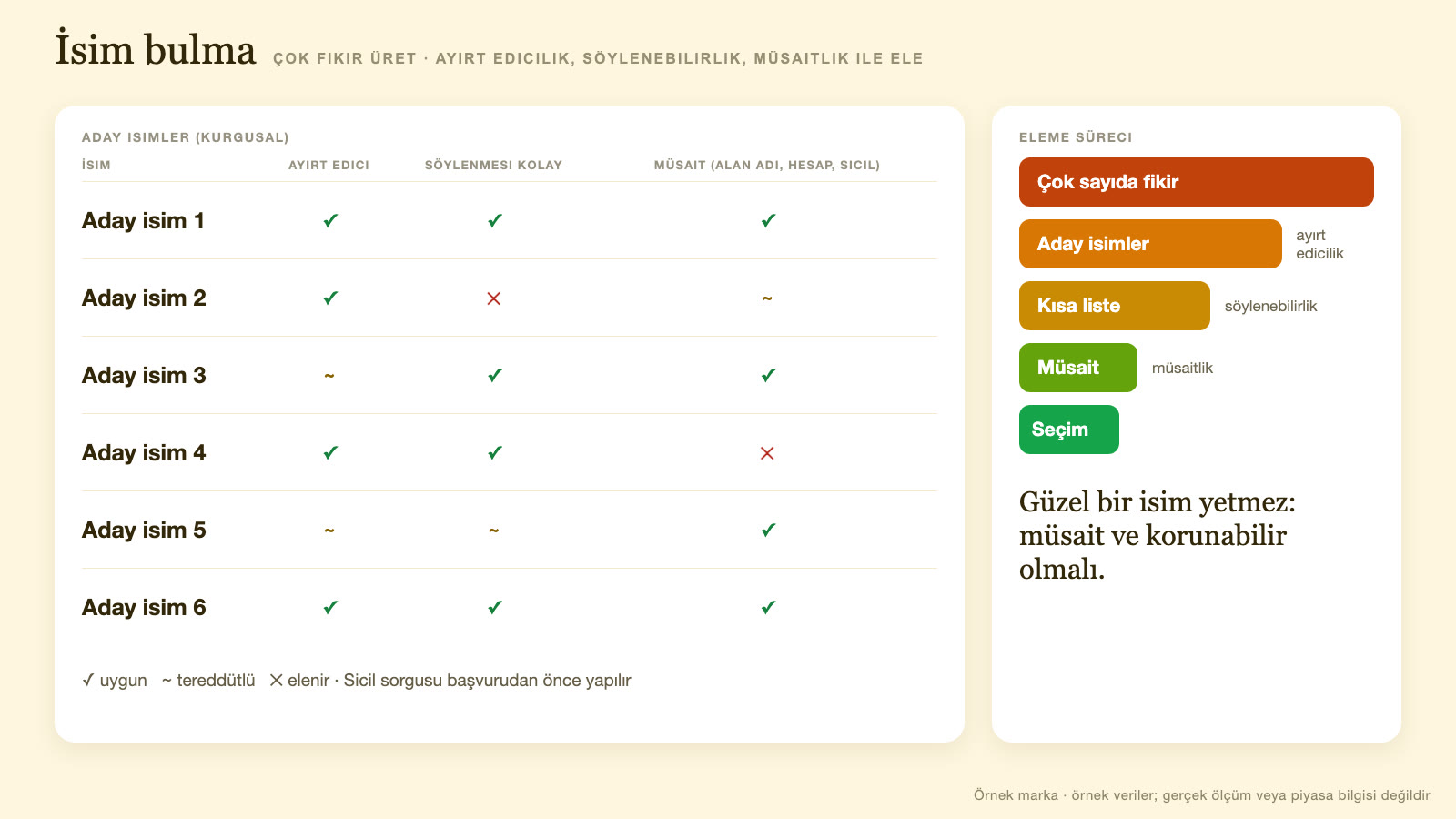
- Distinctiveness: Clearly different from other names in the industry.
- Memorability: Short, simple and easy to remember.
- Pronounceability and spellability: Clear to pronounce, not confusing to spell. When you say it over the phone, the other person should be able to write it correctly.
- Meaning and association: In keeping with the brand’s personality; carrying no negative, wrong or bad meaning (check in different languages and local dialects).
- Flexibility: The name shouldn’t be limiting when the business grows and its product range widens (for example, the name “Ankara Coffee” can make it harder to expand to other cities and products).
- Legal fit: Not conflicting with someone else’s trademark and being registrable.
- Digital fit: A suitable domain name and social media username being available.
- Global potential: If you plan to expand abroad, check the meaning and pronunciation in different languages.
Ways to generate names
- Word lists and association maps: Collecting words related to the brand’s values and combining, shortening or changing them.
- Root, suffix and compound experiments: Joining two words, adding new endings.
- Inspiration from other languages: Related words in Latin, Greek or other languages (verifying their meanings).
- Story and founding memory: A place, person or event from the brand’s origin.
- Brainstorming workshops: Generating many candidates with the team, customers and target audience.
- AI-assisted idea generation: Can be used to generate many name suggestions, but always separately check the originality and the registration and usage status of the suggestions (see our AI guide).
First generate many candidates (dozens, hundreds), and then filter them by the criteria down to three to five finalists; test the finalists with a few people from the target audience and put them through legal research.
Trademark search: Research before registration
Before applying, the most important step is the trademark search (trademark registration search). The aim is to see whether the same or a similar trademark has already been registered or applied for in respect of similar products and services.
- Search in the official database: In Türkiye, trademark records and applications can be searched through the online search system of the Turkish Patent and Trademark Office. Similar spelling, similar pronunciation and similar meaning should be searched as well as the identical spelling, because similarity isn’t limited to exact sameness.
- Search in the right classes: Similarity is assessed with respect to the same or similar goods and services (Art. 6 of the Industrial Property Law, SMK); however, well-known marks may receive broader protection.
- Logo similarity: For marks containing a figure, visual similarity is also searched (using figurative classifications).
- Commercial and internet research: Similar names actually in use on the market even if unregistered: search engines, domain names, social media, the trade registry and marketplaces. Actual use can be grounds for a later opposition or dispute.
- Expert support: Assessing similarity requires legal interpretation; a trademark attorney can make the search more thorough and reliable.
If the search shows a risk, changing the name now is far cheaper than changing it after registration or after investing in the identity.
Logo and brand identity
Once the name is settled, the brand’s visual and verbal identity is built: the logo, color palette, typography, visual language, tone of voice and usage rules. The logo should be a simple, distinctive sign that works at every size and is delivered as vector files; see our logo design guide and corporate identity guide for details. For registration purposes, when designing the logo, prefer one that is original, your own design and unlike other brands’ marks; sign a written agreement with the designer on copyright and licensing and make sure the rights are transferred to the business.
What is trademark registration and why is it needed?
Trademark registration is the process of having a sign officially recorded as a trademark in specific classes of goods and services. In Türkiye, a trademark application is made to the Turkish Patent and Trademark Office and handled under the relevant industrial property legislation. In 2025, 177,114 trademark applications were filed in Türkiye, 92.9% of them domestic; in the same year 128,823 trademarks were registered (TÜRKPATENT 2025 Annual Report).
Benefits of registration
- Exclusive right: The owner of a registered trademark has the right to use the mark for the products and services within the registration and can prevent others from using the mark or a similar one without permission.
- Legal basis: It provides a strong basis in lawsuits and opposition proceedings in case of infringement.
- Protects the investment: It secures all the money spent on building brand awareness (advertising, design, packaging).
- Commercial value: A trademark can be transferred as an asset, licensed (as in franchising) and valued.
- Makes online protection easier: On marketplaces and social media and in domain name disputes, trademark ownership gives you an advantage when filing claims.
- Trust: A sign of seriousness in the eyes of customers, business partners and investors.
Unregistered trademarks can also receive some protection under certain conditions through actual use, but that protection is limited and hard to prove. As a general rule, registering before the brand becomes known is the safest route.
What can be registered as a trademark?
- Word marks: A name, a word, a group of words or a slogan.
- Figurative and logo marks: A drawing, symbol or logo; the mark can be a shape alone.
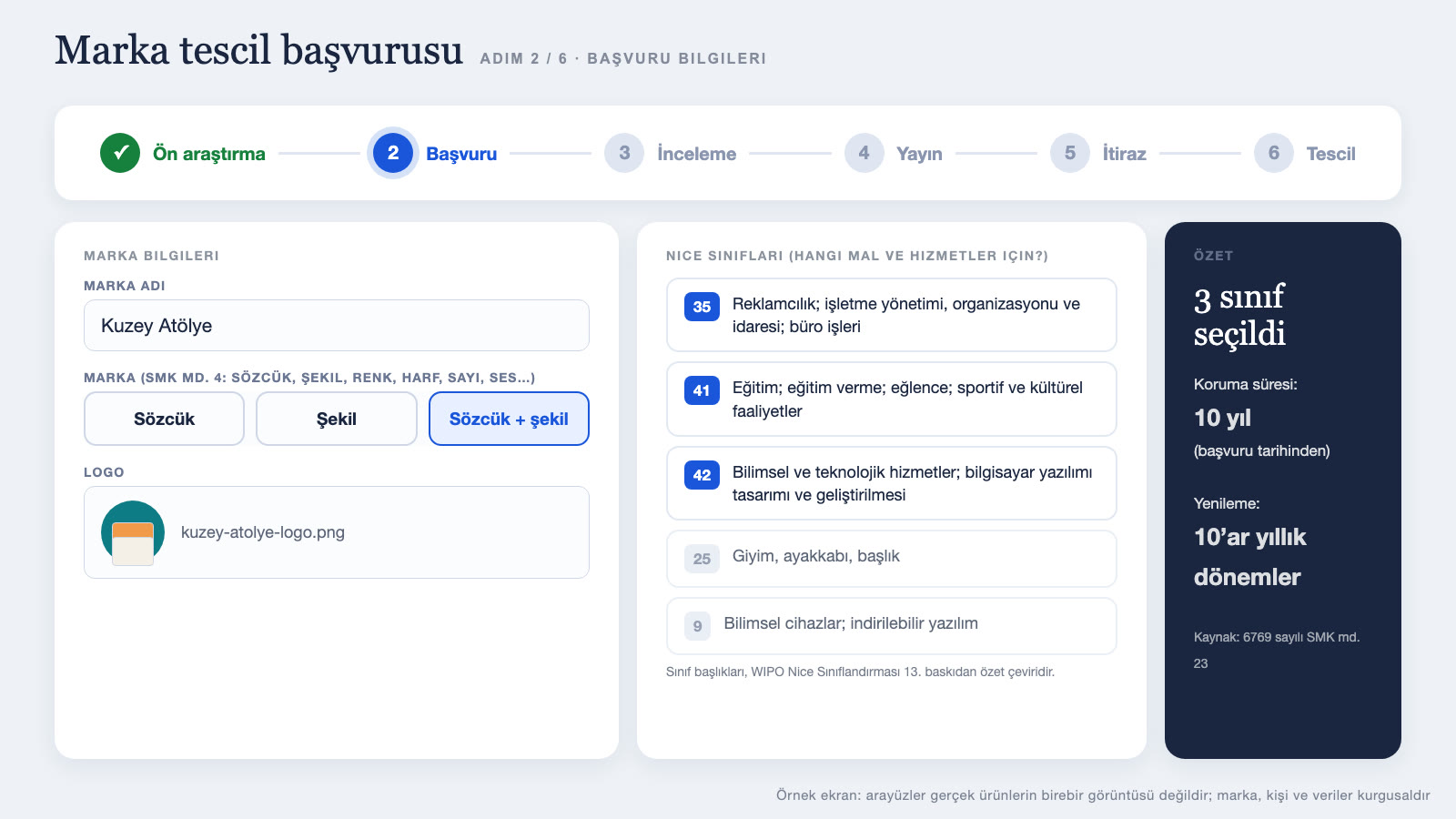
- Combined marks: A mark in which the logo and the word appear together. Getting separate protection for the word alone or the shape alone also widens the protection.
- Letter and number marks.
- Colors, sounds and three-dimensional shapes: To the extent the legislation allows and provided they are distinctive, such as the shape of packaging or a product.
For a sign to be registrable, it must be distinctive, non-descriptive, not misleading, not contrary to public order and morality, and not likely to be confused with a trademark previously registered in someone else’s name. Expressions that directly describe the kind, quality or character of the product (such as “Fresh Milk”) often cannot be registered on their own.
Classes of goods and services
Trademarks are registered for products and services classified under a system generally known worldwide as the “Nice Classification.” This system has 45 classes: Classes 1 to 34 are goods (products) and classes 35 to 45 are services. The Nice Classification is used by about 150 offices worldwide (WIPO). For example, clothing falls in its own class, while restaurant services and advertising fall in the service classes. Registration covers only the products and services in the classes you choose.
- Choose the classes covering your field of activity: Besides the products you sell and the services you provide today, think about areas you will expand into in the near future.
- Choosing too many classes raises cost, and registering in areas you will not really use can lead to non-use problems later. Too few classes, on the other hand, weaken the protection. Strike the balance with a trademark attorney.
- Goods and services list within a class: The description in each class (the list of goods and services) is part of the application; how broadly or narrowly it is written affects the scope of protection.
How do you register a trademark? Step by step
For the questions “how do you register a trademark” and “how do you apply for a trademark,” the general framework is as follows (procedures and deadlines can change over time; check the official guides).
- Preparation and search: The name and logo are settled, a similarity search is run and the classes are determined.
- Determining the applicant: Who you register the brand under matters: in a person’s name or in the company’s name? Because the brand is one of the business’s main assets, registering it in the name of the business (company) is recommended; that way you avoid transfer problems later. Don’t register the brand in the personal name of a founder, agency or designer.
- Preparing the application: The applicant’s details, the image and type of the mark, the selected classes and goods-and-services lists, and the attorney’s details (if any) are prepared. Learn how to apply (application channel, identity verification method) from the office’s current guide.
- Paying the application fee: The application fee, which varies with the number of classes selected, is paid; current amounts are in the office’s official fee schedule.
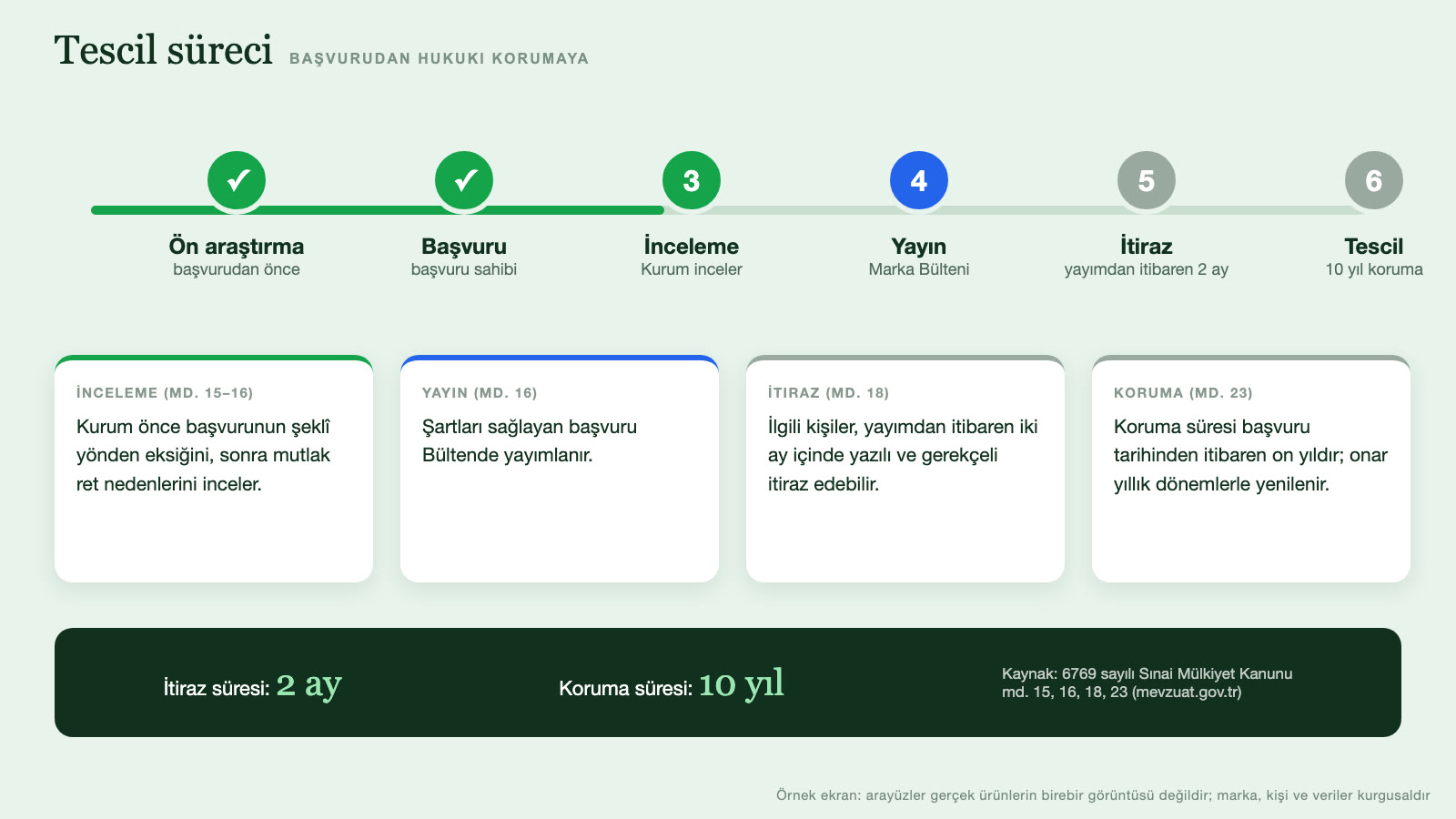
- Formal and preliminary examination: The office checks the formal requirements of the application (missing documents, incorrect information, fee and so on). If anything is missing, the applicant is asked to complete it within a set period.
- Substantive examination (absolute grounds for refusal): The office examines whether the mark can be registered (distinctiveness, descriptiveness, deceptiveness, public order and so on). If it sees a problem, a refusal or a request for correction (for example, narrowing the scope) may follow; a reasoned decision can be appealed within two months of its notification (SMK Art. 20).
- Publication: If the examination is positive, the application is published in the official trademark bulletin; third parties are given the chance to oppose.
- Opposition process: Within a set period after publication (under Art. 18 of Industrial Property Law No. 6769, this period is two months from the publication date), owners of earlier trademarks can oppose the application. If there is an opposition, the office hears the parties and decides; this process can run long.
- Registration fee and certificate: If no opposition is filed or the opposition is rejected, the registration fee is paid and the trademark is registered; a trademark registration certificate is issued.
- Protection period and renewal: A registered trademark is protected for a set period from the filing date (10 years under current Turkish legislation), and this period can be renewed in 10-year terms and extended indefinitely (SMK Art. 23). Renewal is made within the six months before expiry; if missed, it can be done within six months after expiry for an additional fee; otherwise, the right is lost.
The overall duration of the process varies with the office’s workload, the complexity of the application and possible opposition and correction requests. You can start using your brand during this period, but keep in mind the risk of the application being refused or opposed.
Documents and information needed for trademark registration
In general, an application requires the following (the list may be updated; check the official source):
- The applicant’s identity and contact details: For an individual, identity details; for a legal entity, the trade name, tax information and details of the authorized person.
- Representation of the mark: For word marks, the wording; for figurative and combined marks, a clear image file in the specified format and size.
- The selected classes and the goods-and-services list.
- Proof that the application fee has been paid.
- A power of attorney and the attorney’s details, if an attorney is used.
- Additional documents in special cases: For example, a priority claim, extra information for a color or sound mark or explanations of the mark’s meaning.
What determines the trademark registration fee?
Trademark registration fees are not fixed; the office publishes a fee schedule by year on its website. Current amounts are on the TÜRKPATENT Trademark Transaction Fees page. The factors that determine the total cost are:
- Official fees: The application fee and the registration fee; they rise with the number of classes selected. For current amounts, see the relevant office’s official fee schedule.
- Trademark attorney service fee: Support with the search, application preparation, follow-up and any opposition proceedings.
- Number of classes and scope.
- Possible additional procedures: Completing missing items, appealing a refusal, answering an opposition, renewal and monitoring services.
- International protection: Separate fees and expenses for each country or region.
Don’t think of the cost as just the fees; compare it with the cost of lost rights and of an identity change. Registration is a safeguard that protects your brand investment.
Refusal, opposition and common problems
- Absolute grounds for refusal: Obstacles related to the sign itself (lack of distinctiveness, descriptiveness, deceptiveness, being in common use, being contrary to public order). Solution: Make the sign distinctive (an original shape or addition), narrow the scope or choose a different name.
- Relative grounds for refusal and opposition: Oppositions by earlier trademark owners on account of a similar or identical mark. Solution: Do a thorough similarity search in advance; when an opposition arrives, narrow the scope, reach an agreement (for example, a coexistence or withdrawal agreement) or respond to the opposition on legal grounds.
- Bad-faith applications: Some people may register, in their own name, someone else’s well-known mark or a name that person uses; in that case legal routes (opposition, invalidation) come into play. This risk is one of the strongest reasons for early registration.
- Missing deadlines: Missing the deadlines for completion, opposition and renewal can lead to loss of rights; put the deadlines in your calendar or have your attorney track them.
After registration: Use, monitoring and protection
- Use the brand: A trademark that has not been put to genuine use within five years from the registration date, or whose use has been suspended for five consecutive years, can be canceled on request (SMK Arts. 9 and 26). Make sure the brand is used in its registered form and for the registered products and services.
- Proper use: Write the brand consistently in its registered form; don’t stray far from the form in the registration certificate. Use the registration symbol (®) only after registration is complete, for registered marks and in the relevant country.
- Monitoring: Watch the official bulletins and trademark databases regularly to spot new applications similar to your brand and to oppose within the deadline. You can use attorneys or tools that offer trademark monitoring services.
- Acting against infringements: If you notice your brand being used without permission, collect evidence (screenshots, the product, invoices) and get legal support; the options to consider include a warning letter, a platform notice or a lawsuit.
- Renewal: Apply for renewal before the protection period runs out; put the renewal date in your calendar.
- Licensing and transfer: If you let someone else use the brand (a license) or transfer it, put the agreement in writing and have the necessary entries made in the official registry.
- Internal organization: Keep registration certificates, powers of attorney and renewal dates properly on record.
International protection
Trademark rights are protected separately by country (or by region); a trademark registered in one country is not automatically protected in another. If you plan to sell abroad, sell online, export or franchise, protection in the target countries should be considered as well. For international trademark protection, there are international systems that can cover several countries with a single application (for example the Madrid System, through which protection in 133 countries can be sought with one application and one set of fees) and regional application options; filing separately in each country is also possible. Which route is suitable depends on the target countries, the budget and the timing (in the Madrid System, fees vary with the countries and the number of classes selected); getting support from an experienced trademark attorney is useful here. In applications there are time advantages such as the “right of priority”: For foreign applications filed within six months of the first application, the priority right arising from the Paris Convention can be used (SMK Art. 12 regulates its Turkish counterpart).
Choosing a trademark attorney
Applicants resident in Türkiye can file the application themselves (persons resident abroad can act only through a trademark attorney, SMK Art. 160), but because search, class selection, opposition and deadline tracking require expertise, working with a trademark attorney can be useful. When choosing an attorney, look at the following:
- Authority and experience: Official authorization as a trademark attorney and experience in similar cases.
- Scope of service and transparent fees: Separate fees for search, application, follow-up, opposition and renewal services.
- Communication and updates: Timely written information at every stage of the process.
- Risk assessment: Honestly explaining the chance of success and the risks; not promising “guaranteed registration.”
- Documents and ownership: Make sure the application is made in the business’s name and that the registration certificates are delivered to you.
Brand ownership and contracts
Ownership problems with a brand can stem from “practical” steps taken at the start. Pay attention to the following: Make the registration application in the business’s own name; state in the partnership agreement who owns the brand among the partners; sign a written agreement with the designer or agency that made the logo and identity design stating that all rights are transferred to the business; put contracts in place for the rights to brand materials produced by employees and outside contractors; and clarify the terms of use when franchising and licensing. These arrangements are the most important safeguard in any disputes that may arise later.
Common mistakes
- Choosing a name without a strategy: Moving on to the name and logo without deciding what the brand will say.
- Choosing a descriptive, ordinary name: Names that aren’t distinctive and make registration and protection harder.
- Starting to use it without research: Investing without checking whether a similar registered trademark exists.
- Delaying registration: Applying after the brand has become known and letting someone else get ahead.
- The wrong applicant: Registering the brand in the personal name of a founder, the agency or the designer.
- Choosing too few or the wrong classes: Protection that doesn’t cover your field of activity.
- Copying a logo from someone else or using unlicensed images.
- Missing deadlines: Not tracking the opposition, completion and renewal deadlines.
- Not using the brand: Registering and then waiting without using it.
- Not monitoring: Noticing similar applications but not opposing within the deadline.
- Neglecting the domain name and social media accounts: Settling on a brand without checking whether the name is available.
- Getting legal support late.
Example scenario: A natural cosmetics startup
This example is fictional; it doesn’t describe a real startup.
Two entrepreneurs are launching a new brand making handmade natural soap and skincare products. At the start they opened social media accounts and began selling the products, but they have not yet taken any steps on the brand name, logo or registration.
Strategy: First they do a brand strategy exercise: The target audience is informed women aged 25–45 looking for natural products; the brand personality is warm, simple and respectful of nature; the promise is “fewer ingredients, clear effect.” Within that frame, they look for a suggestive name, not a coined one, that connects to the industry.
Naming and research: In a workshop, about a hundred name candidates are generated; using the criteria of distinctiveness, pronunciation and memorability, they are cut to 10 and then three. A similarity search is run in the official database for the three candidates (identical spelling, plus similar spelling and pronunciation); domain name and social media username availability is checked. One candidate is eliminated because a very similar registered trademark turns up in the cosmetics class. The chosen name is found both available and distinctive; then a trademark attorney also confirms the preliminary assessment.
Identity and application: The logo and identity work is done with a designer; in the design contract all rights are transferred to the company behind the brand. The application is made in the company’s name: First, for the combined (word and logo) mark, the cosmetics and soap class and the service class for the retail sale of these products are selected; as the budget allows, a separate application for the word mark alone is also planned.
Process and protection: After the application, the examination and publication stages are followed; during the publication period they watch for new applications similar to their own brand. When registration is complete, the certificate is archived and the renewal date is put in the calendar. The brand is used consistently on products and on the website; when overseas sales are planned, research is started for protection in the target countries as well.
What matters in this scenario is doing the strategy, name research and registration plan before starting to use the brand, and settling the rights question in the company’s name and in writing.
Brand creation and registration checklist
- Have the brand’s purpose, target audience, personality and positioning been written down?
- Have many name candidates been generated and filtered by criteria?
- Has it been confirmed that the name is distinctive, memorable, pronounceable and flexible?
- Have the names been checked for negative or wrong meanings in different languages?
- Has the official database been searched for identical and similar trademarks?
- Has the availability of the domain name and social media username been checked?
- Are the logo and identity original, simple and designed to work at every size?
- Is there a written agreement transferring the rights to the design and software to the business?
- Is the registration application planned in the business’s name, with the right classes and goods-and-services lists determined?
- Are the required documents and the application fee ready?
- Are the opposition, completion and renewal deadlines in the calendar?
- Have brand use, monitoring and what to do in case of infringement been planned?
- If there is an overseas plan, has international protection been considered?
- Have the important decisions been reviewed with a trademark attorney or legal counsel?
If you want to carry out brand strategy, naming, logo and identity work together, take a look at our brand and strategy services. For registration procedures, we recommend getting legal support from an authorized trademark attorney.
Mini glossary: Brand and registration terms
- Brand: The sign and perception that distinguish products and services from those of others.
- Trademark registration: Having the brand recorded at the official office and obtaining an exclusive right.
- Trademark search: Searching the records for identical or similar trademarks.
- Class (Nice Classification): The international classes in which the products and services to be registered are grouped.
- Distinctiveness: A sign’s ability to set a business’s goods and services apart from others.
- Absolute ground for refusal: An obstacle to registration arising from the sign itself.
- Opposition: The legal filing an earlier right holder makes against a published application.
- Trademark attorney: An authorized professional representative for trademark applications.
- Protection period and renewal: The period for which registration is valid, and extending that period.
- Right of priority: The right to benefit from the same date abroad within a set period from the first application date.
- Trade name: The business’s legal name in the trade registry.
Frequently asked questions
How do you create a brand?
First you set the brand strategy (purpose, target audience, differentiation, personality, positioning); find a distinctive name and research it for registrability and usability; design the logo and identity; and use the brand consistently and protect it legally through registration.
How do you register a trademark?
You run a similarity search, choose the classes of goods and services, determine the applicant (preferably the business), apply to the relevant office and pay the fee; after the formal and substantive examination, publication and opposition stages, you receive the registration certificate. The trademark must be renewed before the protection period runs out.
How do you run a trademark search?
In the relevant office’s online search system, search for identical and similar forms of the name and logo in the relevant classes; also check internet, domain name, social media and trade registry records. Because assessing similarity requires expertise, we recommend getting support from a trademark attorney.
What documents are needed for trademark registration?
In general you need the applicant’s identity and contact details (the trade name and tax information if it is a company), a representation of the mark, the selected classes and goods-and-services list, proof of payment of the application fee and, if an attorney is used, a power of attorney. Check the official source for the current list.
How much does trademark registration cost?
Official fees vary with the number of classes selected and can be updated; the trademark attorney’s service fee and possible additional procedures (opposition, renewal) also affect the cost. For current amounts, see the relevant office’s official fee schedule and attorney quotes.
How long does trademark registration take and how many years does it protect?
The time varies with the examination workload and whether there is an opposition; no exact time can be promised. A registered trademark is protected for a set period from the filing date (10 years under current Turkish legislation) and can continue to be protected by renewing it before the period runs out.
Conclusion
Creating a brand is less about choosing a name and a logo than about building a distinctive identity on a clear strategy; registration gives that identity legal security. Starting with strategy, generating many name candidates and filtering them for distinctiveness, pronounceability and availability, running a careful trademark search before registration, applying with the right classes and the right applicant, tracking deadlines, using and monitoring the brand and getting expert support when needed will keep one of a business’s most valuable assets safe for years. As a brand gains value, protecting it matters more; that’s why dealing with registration and the rights framework early is the safest and most economical route in the long run.
This article was prepared with AI support. The images in the article are sample screens drawn with code; they don’t show a real client, person, place or data.
Brand Consultant, Media Fish. Writes on our blog about brand strategy, corporate identity, positioning and brand creation.