What Is SEO and How Do You Do It? A Search Engine Optimization Guide
SEO is the work of getting your website to appear high in search engines, without paying for clicks. A step-by-step guide to technical foundations, content, links and measurement.
 Melis Ay ÜreğenSoftware Engineer16 min read
In Brief
SEO (search engine optimization) is the work of earning a website high, unpaid positions in search results. It rests on three pillars: technical foundation (speed, mobile-friendliness, crawling), content (useful pages that match keywords and user intent) and reputation (links from trusted sites). According to Google, some changes take effect within hours and others take months.
- SEO isn’t about tricking search engines. It’s about giving the user the most useful answer to their question on a site that is fast, trustworthy and easy to understand.
- Technical foundation, content and links work together; if one is missing, the impact of the others stays limited.
- SEO is not a one-off job. It is a measured, regularly updated process, and results take time.
Table of Contents
When someone types “teeth whitening prices” or “best accounting software” and hits Enter, the first few results are the most visible spots on the page. That’s why the goal is for your site to appear at the top for relevant searches. SEO (search engine optimization) is the work of getting your site into those top positions and making it visible without paying for ads.
In this article we answer what SEO is and how to do it step by step: how search engines work, the three pillars of SEO, keyword research, on-page edits, technical SEO, content and link building, local SEO, measurement, SEO pricing, timelines, how it relates to AI and the future of search, and common mistakes. Because search engine rules are updated constantly, also follow the official guidelines (for example, Google’s Search Central documentation) for details.
What is SEO?
SEO stands for “Search Engine Optimization.” It covers every technical, content and reputation effort that helps your website earn high organic (free, ad-free) positions for relevant searches.
SEO is not “fooling the search engine.” A search engine’s goal is to give the user the best answer to their question; SEO is making it clear, to both people and bots, that your site provides that answer. So making your site fast, clear, trustworthy and useful serves both the user and the search engine.
How do search engines work?
To get a sense of scale: Google’s index covers hundreds of billions of web pages and is well over 100 million gigabytes in size (Google, How Search Works). We can summarize how search engines work in three stages:
- Crawling: A search engine’s bots discover web pages by following links. If no link points to a page, or if bot access is blocked, the page may never be discovered.
- Indexing: The content of a crawled page is analyzed and added to the search engine’s huge database (the index). Not every crawled page gets indexed; low-quality, duplicate or blocked pages can be left out.
- Ranking: When a user searches, the pages in the index are ordered by a large number of signals, such as relevance to the query, content quality, trustworthiness, user experience, location and device (for example, meaning, relevance, quality, usability and context).
SEO work aims to remove obstacles and create opportunities at all three stages: The site must be crawlable, valuable pages must be in the index, and those pages must be relevant and strong for the search.
The three pillars of SEO
- Technical SEO: The site’s infrastructure: speed, mobile-friendliness, security, crawling and indexing settings, site structure, structured data.
- Content and on-page SEO: Useful content that matches keywords and user intent, plus the way titles, descriptions, subheadings, images and internal links are set up.
- Off-page SEO and reputation: Links from other sites, mentions, brand searches, reviews and overall trustworthiness.
These three pillars are like the three legs of a stool. A site with technical problems can’t show off its good content; a site without content can’t offer the answer people are looking for, however fast it is; and a site with no reputation falls behind in competitive searches.
Keyword research
SEO starts with understanding what your customers are looking for. Keyword research means finding the phrases your target audience types into search engines and mapping them to pages.
Search intent
Every search carries an intent. Telling the following four intent types apart helps you structure content correctly:
- Informational intent: “What is SEO,” “how to create a corporate identity.” Searches answered by guides and blog posts.
- Navigational intent: Searches to reach a specific site or brand, such as a brand name.
- Commercial investigation intent: “Best X,” “X comparison,” “X reviews.” Someone comparing options before buying.
- Transactional intent: “Buy X,” “X price,” “get X done,” “X near me.” Someone ready to buy.
The page type must match the intent of the search: Showing a product page to someone seeking information, or a long article to someone shopping for a product, doesn’t fit the search intent.
Research steps
- List seed keywords: Core phrases describing your products, services and customer problems.
- Expand them: A search engine’s autocomplete suggestions, the “people also ask” box and related searches show real user language. Keyword tools provide estimated search volume and difficulty.
- Look at competitors: What topics do the sites that rank cover, which questions do they answer and what gaps do they leave?
- Prioritize: Rank keywords by criteria such as search volume, competitive difficulty, fit with your business and closeness to a sale. Consider starting with “long-tail” (longer, more specific) phrases with a clear intent.
- Map them to pages: Choose a single focus page for each main keyword group; don’t cover the same topic on many pages and make your own pages compete with each other.
As we did while preparing this article, looking at search suggestions quickly shows which subtopics people care about. And when you cover a topic, trying to answer all of users’ related questions produces content that is more valuable to both people and search engines.
How to do on-page SEO
On-page SEO means making each page’s topic clear to both users and search engines. The key elements are:
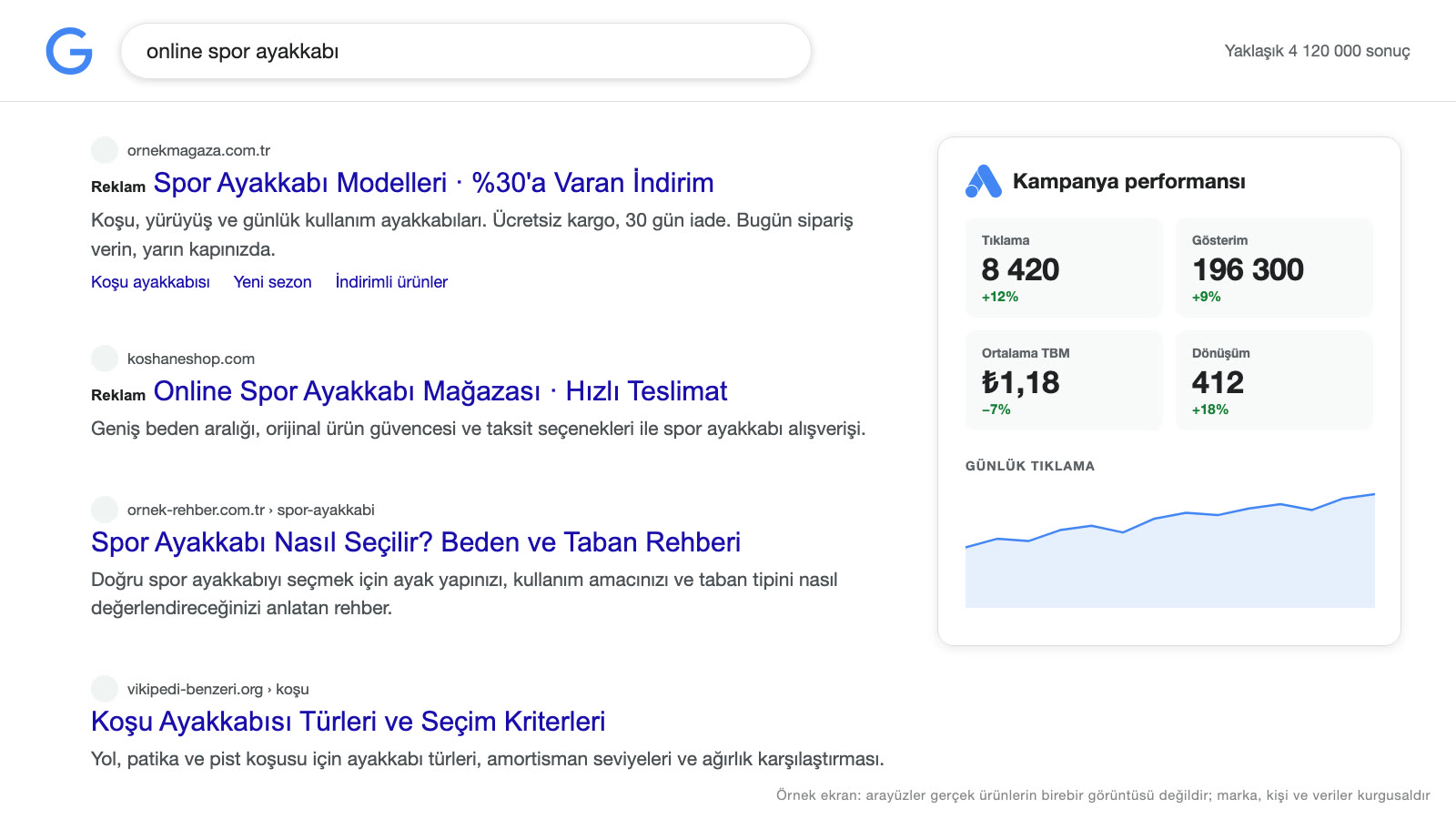
- Page title (title tag): It appears as the blue link in search results. It contains the main keyword, describes the page accurately, and is short and worth clicking. Google doesn’t set a limit on title length, but it truncates long titles to fit the device’s screen width (Google Search Central); put the important words first.
- Meta description: The summary shown under the title in results. Google may use this text in the result snippet; write a short, original text that explains what the page offers and why someone should click.
- Main heading (H1) and subheadings (H2, H3): They show the content hierarchy of the page. Use one H1 per page, and H2s and H3s for the subsections of the topic.
- Content: Text that covers the topic completely, accurately and clearly, and stays up to date. Instead of forcing the keyword in repeatedly, use related phrases on the topic in natural language.
- URL structure: Short, readable addresses that describe the topic. Minimize special characters (such as Turkish letters) and unnecessary parameters.
- Images: Meaningful file names, descriptive alt text and optimized sizes. Alt text provides meaning both for visually impaired users and in image search.
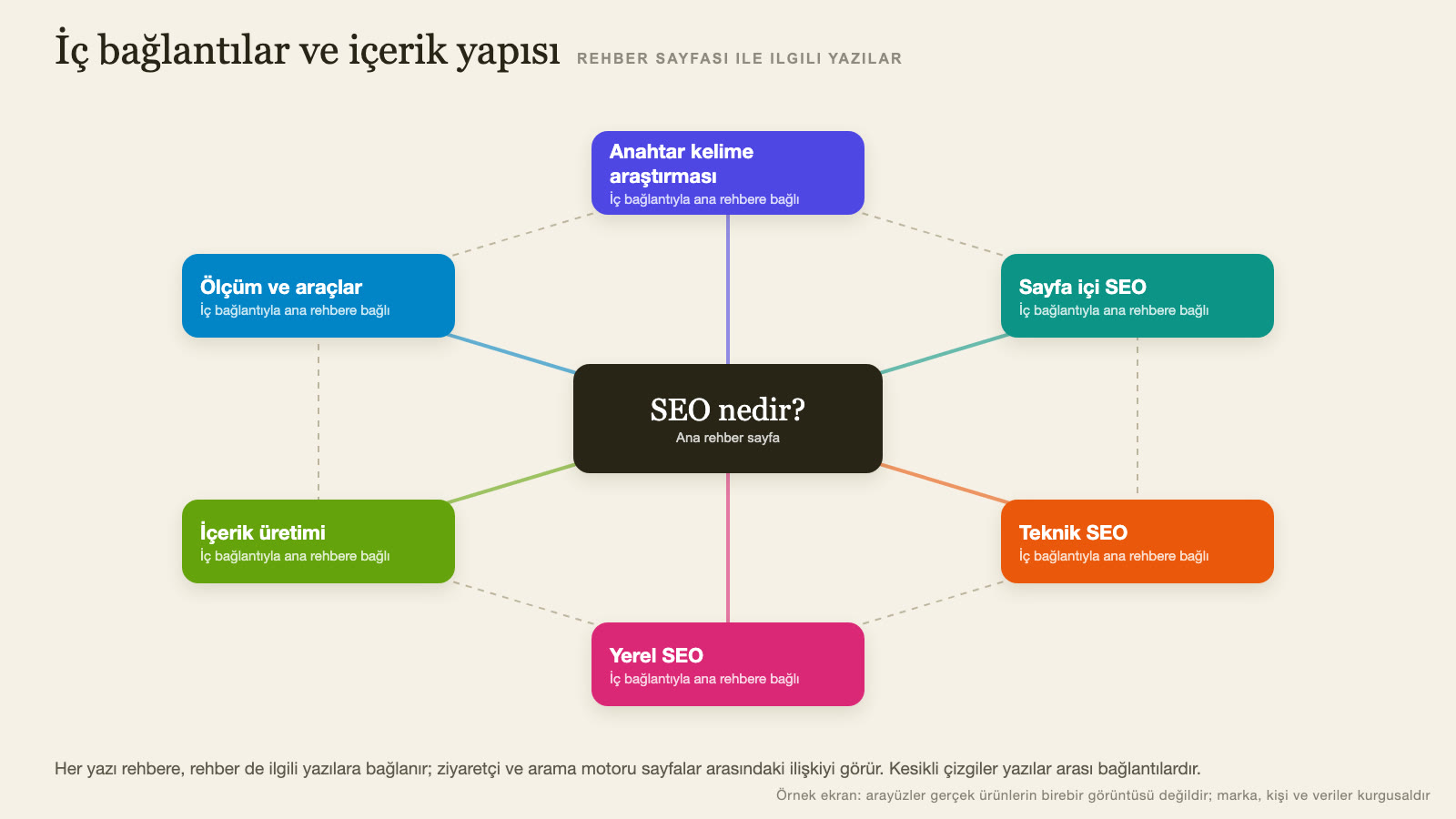
- Internal links: Link related pages to each other; the link text should describe the topic of the target page (“SEO guide” instead of “click here”).
- Call to action: Guide the visitor to the next step: contact, a quote, a purchase, a related article.
Technical SEO
Technical SEO makes sure your site works well so search engines can crawl it and users can use it comfortably. It’s invisible to visitors but forms the foundation of the site.
Speed and mobile-friendliness
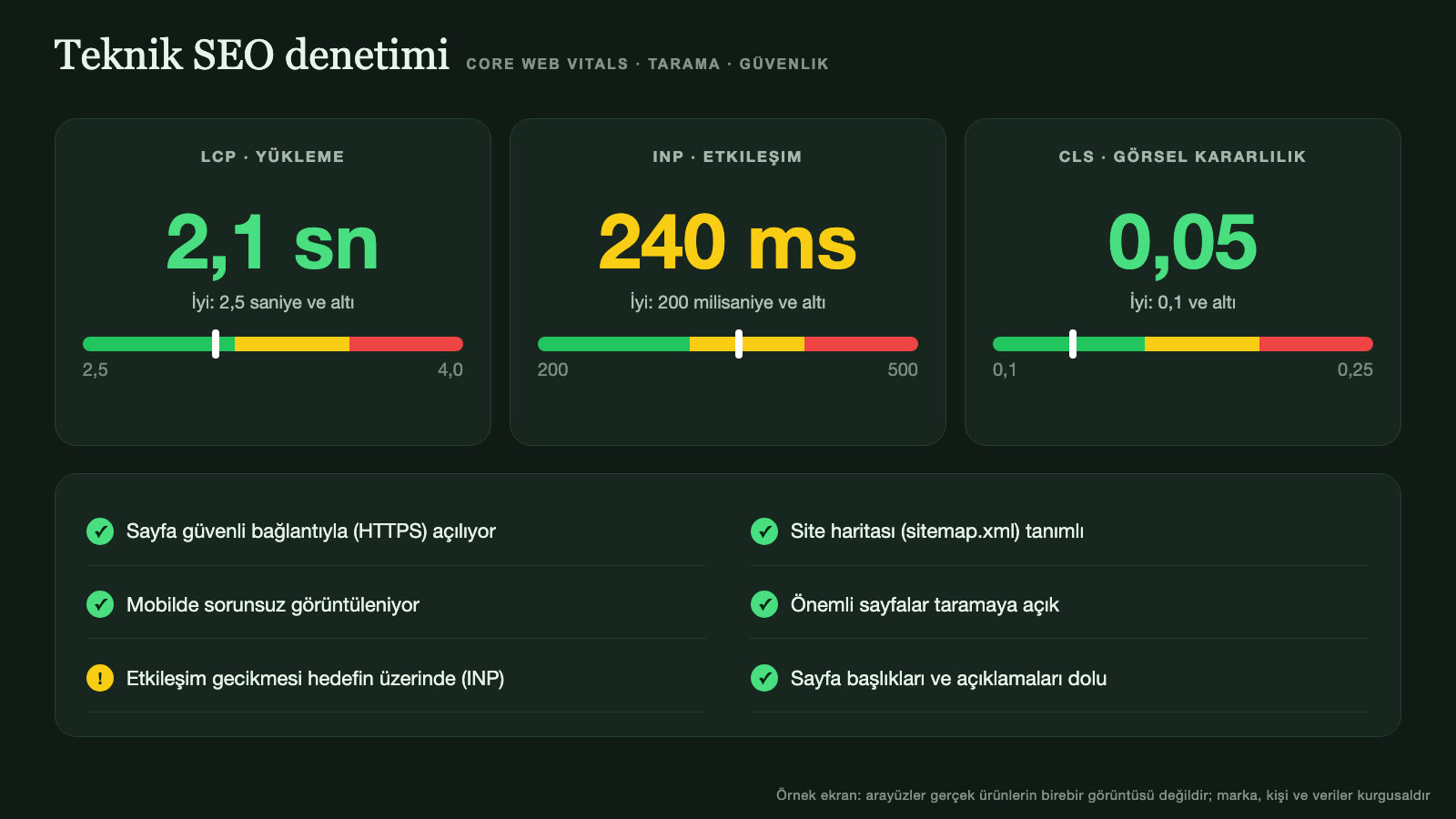
Fast page loading and smooth performance on mobile matter for both user experience and rankings. Google uses “Core Web Vitals” metrics, which measure page experience: the loading time of the largest content (LCP), responsiveness to interaction (INP) and visual stability (CLS). To improve speed, optimize images, cut unnecessary code and plugins, use reliable hosting, and take advantage of solutions such as caching and a content delivery network. Google indexes based on the mobile version, so the mobile version must carry the same content as the desktop one.
Security and site structure
- HTTPS: Use a secure connection; all pages should load over HTTPS.
- Logical site structure: A clear hierarchy from the home page to categories and subpages; important pages should be reachable in a few clicks.
- Sitemap: A file that lists the site’s important pages for the search engine; it is submitted through the search console.
- Robots file: Tells search engine bots which sections not to crawl; if set up incorrectly, important pages can be blocked.
- Canonical URLs: If the same content is reachable at multiple addresses, specify the preferred one; this prevents duplicate content problems.
- Redirects and error pages: Set up proper (permanent) redirects for moved or deleted pages; fix broken links and faulty pages.
- Structured data: Code that describes content types such as business information, FAQs, products and articles to the search engine explicitly; it can enable rich results in some listings.
New sites and migrations
So that SEO doesn’t reset when you redesign a site or change domains, you need to set up permanent redirects from old pages to their new addresses, keep titles and content, update the sitemap, and monitor crawl errors after the move. That’s why you should include SEO needs from the very start of site design; our corporate website guide is useful for this planning.
Content production and content SEO
A search engine’s goal is to show the page that best answers the user’s question. That’s also the foundation of content SEO: covering the topic more completely, accurately and clearly than competitors, and keeping it more up to date. To do that:
- Answer the user’s question directly: Open with a short, clear summary, then give the details.
- Cover the topic in depth: Add related sub-questions, examples, steps and common mistakes.
- Write trustworthy content that shows expertise: Real experience, sources and accurate information; elements that reflect the author’s or business’s expertise. Google says it considers experience, expertise, authoritativeness and trustworthiness (E-E-A-T) when evaluating content quality.
- Update content regularly: Outdated information damages trust and rankings.
- Don’t copy: Content taken from other sites or repeated on the same site creates no value.
- Be readable: Short paragraphs, subheadings, bullet points, tables and images.
You can produce content with AI tools, but keep in mind that search engines target low-quality, mass-produced content that lacks originality. AI can help with drafts and research; the final content must be verified and enriched with original information (see our article on AI content production for details).
Blog and content strategy
A blog is one of the most effective tools for letting a site answer different search intents. Plan topics according to the customer’s decision journey, not at random: “what is” for awareness, “how to choose, comparison” for evaluation, “price, reviews, FAQs” for the decision. Every post should link to the relevant service or product page and to other posts. Long, sectioned content that opens with a short summary and ends with FAQs, like this article, makes the topic clear to both readers and search engines.
Links and reputation (off-page SEO)
Other sites linking to you (backlinks) is a trust signal for search engines: “This content is considered valuable by others too.” But the quality and relevance of links matter as much as their number.
- How do you earn quality links? By producing genuinely valuable content (guides, research, tools), contributing to industry publications, appearing in press and event coverage, being featured on partners’ and associations’ websites, and being mentioned in local directories and on organizations’ sites.
- What to avoid: Buying links, joining automated link networks and leaving mass links in comment sections violate search engines’ spam policies and can lead to ranking drops or removal from results.
- Brand searches and mentions: People searching for your brand and mentioning it on social media and in the news also create reputation signals.
- Reviews and trust: Especially for local businesses, customer reviews increase visibility and trust.
Reputation work is the part of SEO that takes the most time and patience. Instead of looking for shortcuts, focus on creating value in a sustainable way. Brand awareness work also supports SEO indirectly over time by increasing brand searches.
Local SEO
For businesses serving customers in a particular area, the local side of SEO aims to be visible for “near me” and “city name + service” searches. The basic steps: Fill out your Google Business Profile completely, write your business name, address and phone number consistently everywhere, build pages that fit local keywords, collect reviews and earn mentions from local sources. For detailed setup, see our Google Business Profile guide.
SEO on platforms: YouTube, Instagram and marketplaces
SEO is not unique to Google; many platforms have their own search engines, and similar principles apply:
- YouTube: The video title, description and thumbnail matter more than tags; tags play a very small role in discovery (YouTube Help).
- Instagram: Instagram matches search text with usernames, bios, post captions and hashtags (Instagram); use phrases relevant to your topic in these fields. Alt text, on the other hand, is for accessibility.
- Marketplaces (for example, e-commerce platforms): Product title, description, category, attributes and images are the core elements of your product page on a marketplace. Each platform has its own rules and algorithms; follow their official guidelines.
User intent, relevant content and engagement are the foundation of visibility on platforms too. For social media account management, you can check our social media management guide.
Measurement and tools
In SEO, measurement shows what works and where to focus. Search engines also change constantly: In 2023 alone, Google ran more than 700,000 experiments and launched more than 4,000 improvements to Search (Google, How Search Works); that’s why results should be monitored regularly. Two free tools are enough to start:
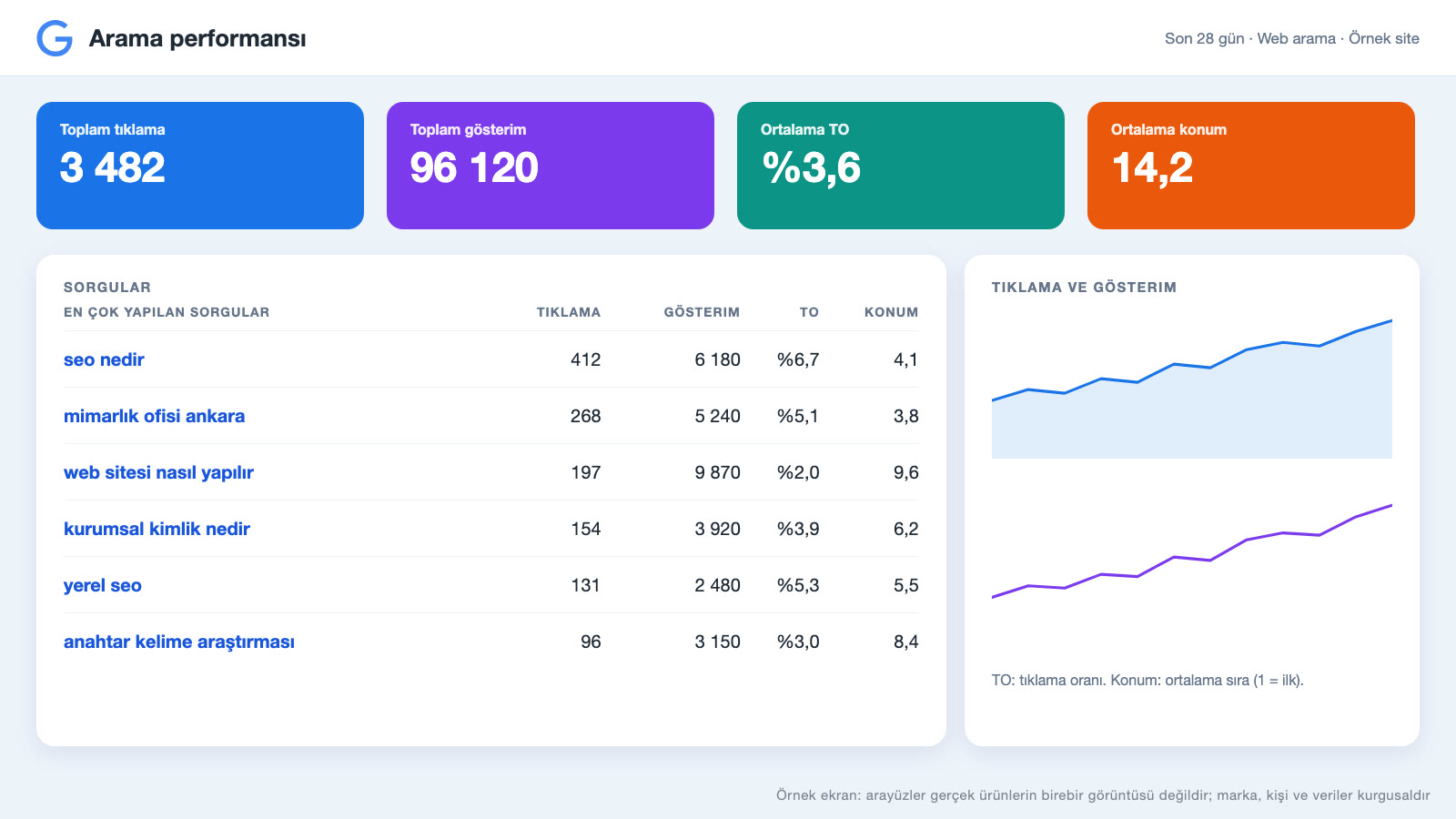
- Search console (Google Search Console): Shows which searches your site appears for, how many clicks it gets, which pages are indexed, crawl errors and page experience issues. You also submit the sitemap here.
- Web analytics (for example, Google Analytics): Shows where visitors come from, which pages they stay on and what actions they take; it’s necessary for conversion tracking.
Key metrics to track: organic clicks and impressions, rankings for target keywords, conversions from organic traffic (forms, calls, sales), the number of indexed pages, page speed and user behavior. Don’t look only at rankings; look at real contribution to the business (leads, sales).
What does an SEO specialist do?
An SEO specialist plans and manages the technical, content and reputation work to increase a website’s visibility in search engines. Daily tasks include keyword and competitor research, technical site audits, content planning and working with content writers, optimizing page titles and content structure, link-building strategy, reviewing search console and analytics reports, and working with developers and designers on site improvements. Besides technical knowledge, a good SEO specialist has the curiosity to understand why users search and strong written communication skills.
For anyone who wants to specialize in this field, the most effective path is learning by doing on your own small site: Setting up a blog or a small business site, doing keyword research, producing content, monitoring the search console and measuring results reinforces what you know and also creates a real work sample. Keep in mind that the field changes quickly and that following search engine updates is a natural part of the job.
A starter SEO plan for a small business
A business with a limited budget and time can start SEO in this order:
- Check the basics: Does the site open properly on mobile, is it fast, is it on HTTPS? Are titles and descriptions unique?
- Set up the search console: Verify the site, submit the sitemap and start monitoring which searches you appear for.
- Strengthen five key pages: Build clear, detailed and persuasive pages for your main services; each should focus on a single main topic.
- Set up local visibility: Complete your business profile and start collecting reviews.
- Publish two posts a month: Write posts that answer your customers’ questions and link to relevant pages.
- Review every three months: Which pages get clicks, which are climbing in rankings and which questions are still unanswered?
This plan doesn’t promise miracles in a short time, but applied consistently it builds a solid foundation that makes a measurable difference. For the basic steps, you can also check our landing page guide.
How long does it take to see SEO results?
It wouldn’t be right to promise a single timeframe in SEO; how long results take depends on the site’s age and strength, industry competition, the quality of the work and the type of content. The general picture is this: According to Google, some changes take effect within hours and others within months (Google SEO Starter Guide). New content can take time to be indexed and gain rankings. Unlike ads, you don’t pay per click for organic rankings. SEO should therefore be planned as patient, ongoing work; when you need quick visibility, it can run alongside ads (our Google Ads guide).
What determines SEO prices?
“SEO prices” is a frequent search, but giving a single price would be misleading. The factors that determine the cost of an SEO service are:
- The site’s current state: The number of technical problems, content gaps and the size of the site.
- Industry and competition: Highly competitive industries require more effort.
- Scope of service: Is it only a technical review, or does it also include ongoing content production, link building and reporting?
- Goals: The scope of your goals, such as local visibility, national rankings or e-commerce product pages.
- Duration and reporting: Monthly or project-based work, and how often reports are delivered.
- Team experience.
When evaluating proposals, be wary of firms that offer “guaranteed first place”; no agency can guarantee a search engine ranking. Make sure it’s clearly written down which tasks will be done, which metrics will be reported and how the process will unfold. We described the role of agencies in our advertising agency guide.
SEO and AI-powered search
The search experience is changing: Many search engines and answer tools now give users AI-powered summary answers directly. These answers can feature source sites. Google states that no additional optimization or special markup is needed to appear in AI-powered features (Google Search Central); basic SEO principles apply, such as crawlability, internal links, good page experience and important content presented as text. We covered this area in detail in our GEO article.
Common SEO mistakes
- Keyword stuffing: Breaking the natural flow of the text by forcing the same phrase in repeatedly.
- Misreading intent: Writing content without looking at what the search actually wants.
- Duplicate content: Using the same or very similar content on many pages.
- Thin, worthless pages: Short, generic pages that offer users no benefit.
- Technical neglect: A slow site, mobile problems, broken links, incorrect blocking settings.
- Buying links: Methods that promise short-term gains but carry a risk of penalties.
- Leaving titles and descriptions empty or duplicated: Every page should have its own unique title.
- Not measuring: Carrying on without knowing which work is paying off.
- Impatience: Giving up, or constantly changing strategy, when you don’t see results within a few weeks.
- Forgetting SEO during a migration: Removing old pages without setting up redirects.
Example scenario: An architecture firm
An architecture firm in Ankara that designs residential and office projects has a beautiful portfolio, but its website was built a few years ago, loads slowly and describes its services in very little detail. Most of its clients come by referral, and the firm wants to win new clients from search engines.
Situation analysis: A technical review shows that the site looks broken on mobile, the images are too large, most pages share the same title and the project pages have almost no text. In the search console, it turns out that most of the searches that find the site are just the firm’s brand name.
The work: First come the technical fixes: mobile-friendliness, image optimization, speed, proper titles and descriptions, a sitemap. Then keyword research: “villa design,” “office interior design,” “architectural project prices,” “how does the permit process work.” A separate, detailed page is built for each service; projects are turned into short case studies (what problem, what solution, what result). A blog section is added, and guides answering clients’ most common questions are published. The Google Business Profile is updated, and project photos are added.
Monitoring: Each month, impressions and clicks in the search console and the inquiries coming through the form and by phone are tracked. Based on the monthly data, the pages that bring the most inquiries are expanded.
In this fictional example, the approach rests not on a single trick but on technical fixes, intent-matched content, regular production and measurement working together.
SEO checklist
- Does the site load over HTTPS and work smoothly on mobile?
- Do pages load fast (images optimized, unnecessary code reduced)?
- Is the sitemap ready and submitted to the search console?
- Does the robots file avoid blocking important pages?
- Does every page have a unique title, a description and a single H1?
- Have keywords been mapped to pages by intent?
- Is the content useful, accurate, current and original?
- Do internal links connect related pages?
- Do images have descriptive alt text?
- Has structured data (business, FAQ, article) been added?
- Is there a plan to earn quality links and mentions?
- Are the search console and analytics set up, with monthly reporting?
If you want to run SEO together with your website, content and advertising, take a look at our digital marketing and web services. To see SEO’s place within overall marketing, read our digital marketing guide.
Mini glossary: SEO terms
- Organic result: Natural search results that are not ads.
- SERP: The search engine results page.
- Keyword: The phrase a user types into a search engine.
- Backlink: A link from another site to yours.
- Indexing: Adding a page to the search engine’s database.
- Crawling: Search engine bots visiting pages.
- Canonical: Specifying the preferred address for the same content.
- Core Web Vitals: Speed and stability metrics that measure page experience.
- E-E-A-T: Experience, expertise, authoritativeness and trustworthiness.
- Long tail: Longer, more specific search phrases with a clear intent.
Frequently asked questions
What is SEO?
SEO is search engine optimization. It covers all the technical, content and reputation work that helps your website appear high in search results without paid ads (organically).
How do you do SEO?
You research keywords and search intent, prepare page titles and content accordingly, fix the site’s technical foundation (speed, mobile-friendliness, security, crawling), produce useful content, earn links from trusted sites, and measure results with the search console and analytics tools.
How long does SEO take to work?
It varies with the industry, the competition and the state of the site; according to Google, some changes take effect within hours and others take months. Promising an exact timeline would not be right.
What’s the difference between SEO and Google Ads?
Ads are paid and fast, and visibility ends when the budget runs out. SEO aims for free rankings and takes time. The two can be used together.
What determines SEO prices?
The site’s condition, competition in the industry, scope of service (technical, content, links, reporting), goals and team experience all affect the price. Proposals that guarantee first place are not reliable.
Will AI end SEO?
It changes the search experience. Google states that no additional optimization is needed to appear in AI-powered features; basic SEO principles apply to those features too.
Conclusion
SEO is the work of making your site understandable, fast, trustworthy and useful for search engines and users. Understanding the right keywords and search intent, building a solid on-page structure and technical foundation, producing original and in-depth content, supporting your reputation with quality links and measuring everything all deliver organic visibility. Instead of shortcuts and promises of guaranteed results, an approach that patiently creates value and keeps improving is the safest and most efficient path in SEO.
This article was prepared with AI support. The images in the article are sample screens drawn with code; they don’t show a real client, person, place or data.
Related work
A few examples of Media Fish’s work on this topic:


E-Commerce Site + SEO + SEM
Design · Software · Publishing

E-Commerce Site + SEO + GEO
Design · Software · Publishing

Corporate Website + SEO
Design · Software · Publishing
Software Engineer, Media Fish. Writes on our blog about web and software, mobile apps, artificial intelligence and search engine optimization (SEO).